
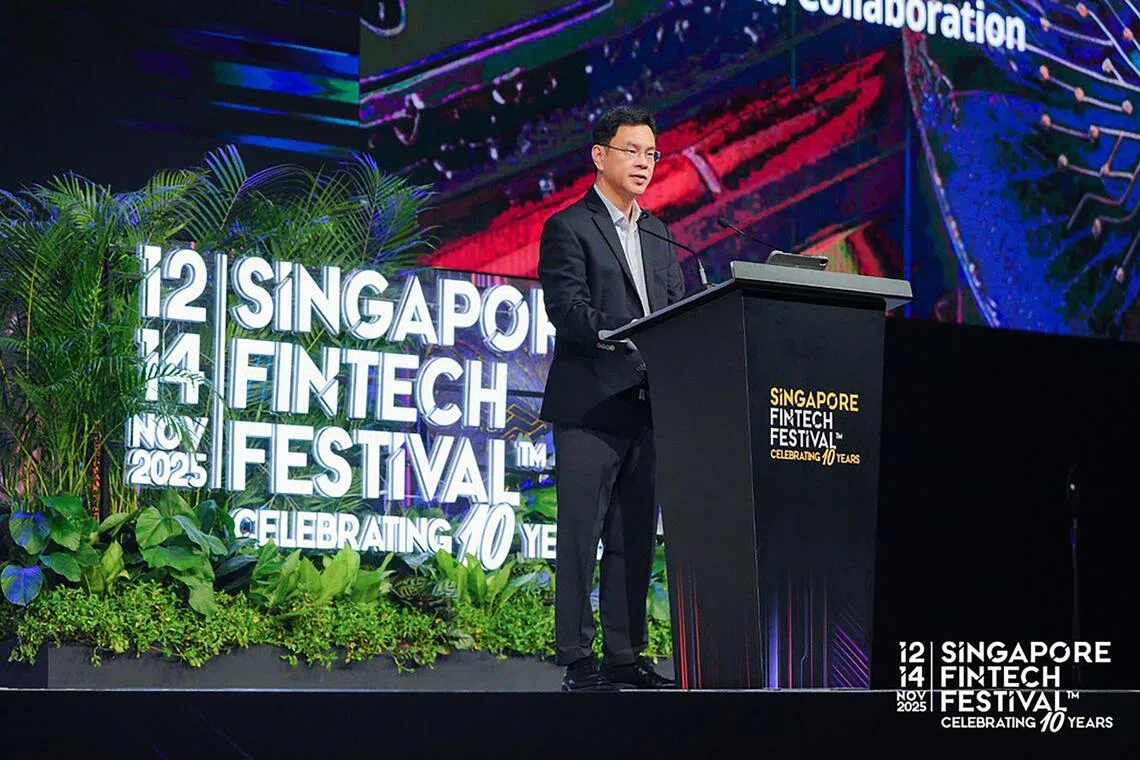
Singapore’s MAS Highlights the Importance of Regulated Stablecoins
In a recent address, Chia Der Jiun, the managing director of the Monetary Authority of Singapore (MAS), emphasized that regulated stablecoins promise greater “value stability” compared to their unregulated counterparts, which have shown inconsistency in maintaining their pegged values. Stablecoins are cryptocurrencies designed to minimize price fluctuations by linking their worth to a stable asset such as a fiat currency or commodity. Mr. Chia cautioned that frequent de-pegging incidents can diminish trust and lead to a rush on other stablecoins, similar to the events witnessed during the 2008 financial crisis when money market funds lost their value, prompting widespread withdrawals from other funds.
Regulatory Framework Crucial for Stablecoin Integrity
During his keynote at the Singapore FinTech Festival 2025, Mr. Chia stressed the necessity of comprehensive regulations for the stability of stablecoins. He noted that while national regulations are rapidly evolving, the emergence of poorly regulated stablecoins could undermine confidence across the board. The MAS has acknowledged the importance of regulating stablecoins and is in the process of finalizing a regulatory framework, which includes a draft of relevant legislation. Mr. Chia highlighted that their regulatory approach prioritizes strong reserve backing and reliable redemption mechanisms. He also pointed out that if some regulated stablecoins gain systemic importance, there will be a need for enhanced regulatory measures, improved international cooperation, and consideration of access to central bank facilities.
Exploring the Future of Tokenised Assets
In addition to stablecoins, Mr. Chia discussed the topic of tokenised assets, which he referred to as “asset-backed tokens.” He remarked that while tokenization has begun to flourish with products like money market funds and cash payment services for corporate treasuries, a future where the majority of financial assets are tokenized and traded on blockchains requires significant advancements in various areas. Tokenisation involves creating digital representations of real-world assets, such as bonds and stocks, on blockchain networks. Mr. Chia indicated that for asset-backed tokens to be effective, standardization is necessary, as well as the development of interoperable networks and a substantial pool of secure settlement assets, supported by institutional-grade infrastructure.
Challenges and Opportunities in Asset-Backed Token Networks
Currently, banks and innovators are competing to build their own networks, each striving for scalability. However, these networks may have differing technical specifications, leading to challenges in the portability of asset-backed tokens across platforms. This lack of interoperability could hinder the advantages of blockchain transactions, potentially resulting in a fragmented ecosystem of isolated networks or a concentration of power within a few dominant entities. Mr. Chia advocated for a collaborative approach, termed “co-opetition,” where industry players work together to establish a marketplace for asset-backed tokens while still competing for market share and liquidity. He emphasized the need for consensus on common standards to ensure that tokens created on one network can be recognized and used on others.
MAS Initiatives to Foster Collaboration in Digital Assets
In 2022, the MAS initiated Project Guardian to investigate the potential of public blockchains in facilitating open and interoperable networks for digital asset trading across different platforms. Following this, the central bank launched Global Layer One in the subsequent year, aimed at exploring new blockchain infrastructures that would enable financial institutions to collaborate and mitigate the risks of liquidity fragmentation. Mr. Chia highlighted that in the context of tokenisation, the concept of money is still evolving, with several candidates for secure and reliable settlement assets, including central bank digital currencies (CBDCs), tokenised bank liabilities, and regulated stablecoins.
Collaborative Efforts for Tokenised Transactions
Mr. Chia noted that for tokenised transactions to achieve global scalability, the settlement assets involved must be robust and secure. Currently, various market players are testing different settlement assets for diverse applications, each needing to prove their utility and safety. He mentioned that the MAS is actively collaborating with industry partners to explore the role of CBDCs, tokenised bank liabilities, and regulated stablecoins. The recently launched Borderless, Liquid, Open, Online, Multi-currency initiative encourages financial institutions and clearing networks to conduct trials involving tokenised bank liabilities and regulated stablecoins for settlement purposes.
Advancements in CBDC Trials
In a significant development regarding CBDCs, Mr. Chia announced that DBS Bank, OCBC Bank, and UOB successfully executed interbank overnight lending transactions using Singapore’s first live trial issuance of a wholesale CBDC for settlement. Looking ahead, the MAS plans to trial the issuance of tokenised MAS bills to primary dealers, with settlements conducted via CBDCs. Further details regarding this initiative are anticipated to be released in 2026. Mr. Chia concluded his remarks by stating that building a tokenised future requires collaboration between public and private sectors, as well as cooperation across jurisdictions. The Singapore FinTech Festival, which features prominent speakers including Deputy Prime Minister Gan Kim Yong and UOB’s chief executive Wee Ee Cheong, continues until November 14.


